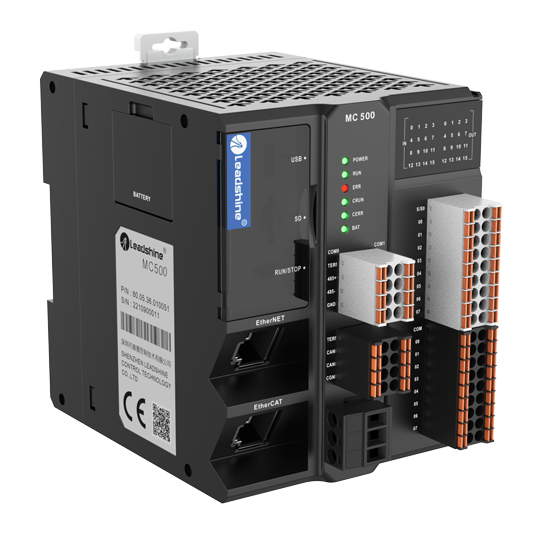
The architecture of industrial automation is undergoing a fundamental shift. For decades, the factory floor was dominated by the traditional industrial PLC—a rugged, reliable device dedicated solely to executing logic and controlling machinery. However, the rise of the Industrial Internet of Things (IIoT) has introduced a new player: the Edge PLC. As manufacturers seek to extract more value from their data, understanding the differences between these two technologies is crucial. Companies like Leadshine are at the forefront of this evolution, offering controllers that blend the reliability of traditional hardware with the advanced connectivity required for modern smart factories.
The Traditional PLC: Reliability in Isolation
The traditional industrial PLC was designed with one primary goal: robust, deterministic control. Its job is to read inputs, execute logic, and drive outputs with millisecond precision, day in and day out, for years. These devices excel in harsh environments where vibration, dust, and electrical noise are common. However, they were often designed as “black boxes.” Data generated by the machine stayed in the machine. Extracting that data for analysis often required complex middleware, expensive gateways, and proprietary cables. While excellent for local control, the traditional architecture struggles to meet the connectivity demands of the modern IT-driven enterprise.
The Edge PLC: Bridging IT and OT
An Edge PLC (or Edge Controller) retains the ruggedness of a standard controller but adds a layer of computing power and connectivity typically found in PCs. The key difference lies in data processing. Instead of sending raw, voluminous data to a central cloud server (which can be costly and slow), an Edge PLC processes data locally—”at the edge” of the network. It filters, aggregates, and analyzes information in real-time before transmitting only the relevant insights. This architecture reduces bandwidth usage and latency, making it ideal for predictive maintenance and real-time analytics applications that traditional industrial PLC systems cannot support alone.
Connectivity: Protocols and Portability
The most visible difference between the two architectures is the language they speak. Traditional PLCs typically rely on fieldbus protocols like Profibus or Modbus RTU, which are optimized for local control but not for the internet. In contrast, modern controllers, such as the advanced series from Leadshine, support IIoT-native protocols like MQTT and OPC UA. These protocols allow the controller to publish data directly to cloud platforms or SCADA systems securely and efficiently. This native connectivity eliminates the need for intermediate hardware, simplifying the network architecture and reducing the potential points of failure.
The Role of the Small PLC Controller in IIoT
In the past, a small PLC controller was relegated to simple tasks—opening doors, turning on lights, or running basic conveyors. In an IIoT architecture, however, the role of the small PLC controller has expanded significantly. Devices like the Leadshine SC Series prove that compact size does not equate to low intelligence. These small controllers can now act as intelligent nodes, gathering sensor data from distributed assets and communicating it back to a central master or the cloud. This allows manufacturers to instrument legacy machines or isolated stations cost-effectively, bringing them into the connected ecosystem without a massive overhaul.
Processing Power and Motion Integration
Edge PLCs often boast significantly higher processing power than their traditional counterparts. This is necessary not just for handling network traffic but for integrating complex motion control algorithms. Leadshine has leveraged this in their MC Series, which combines logic control with multi-axis motion control. By integrating functions like electronic cams (E-CAM) and linear interpolation directly into the industrial PLC, the system can react faster to changes. For example, torque data from a servo motor can be analyzed locally to detect mechanical wear (an edge computing task) while simultaneously maintaining precise synchronization of the production line (a traditional control task).
Security and Software Architecture
Security is a major differentiator. Traditional PLCs were built for air-gapped networks where physical access was the only threat. Connecting them directly to a network poses significant risks. Edge PLCs are designed with security in mind, often featuring encrypted communication and user authentication layers. Furthermore, the software architecture is different. While traditional units are programmed almost exclusively in Ladder Logic, edge-capable controllers from Leadshine support the full IEC 61131-3 standard (including Structured Text) and often allow for integration with high-level languages. This makes them more accessible to a new generation of engineers who are comfortable with both IT programming and OT logic.
Why Leadshine Bridges the Gap
The choice between “Traditional” and “Edge” is rarely binary; most factories need a hybrid approach. Leadshine understands this reality. Their product portfolio, detailed on their PLC control page, ranges from the robust, high-performance MC series—capable of handling complex EtherCAT networks and edge tasks—to the efficient small PLC controller options in the SC series. This diversity allows engineers to deploy the right level of intelligence at every point in the process. You can use a high-powered MC controller as the main “edge gateway” for a production line while using smaller, cost-effective units for decentralized tasks, all within a unified ecosystem.
The Best of Both Worlds
Ultimately, the transition to IIoT does not mean abandoning the reliability of the traditional industrial PLC. It means augmenting it with new capabilities. By selecting versatile controllers that offer both the deterministic performance of the past and the open connectivity of the future, manufacturers can build resilient, future-proof architectures. Whether you are upgrading a single machine with a small PLC controller or digitizing an entire facility, Leadshine provides the technology to bridge the gap between the factory floor and the cloud, ensuring you stay competitive in the age of smart manufacturing.
