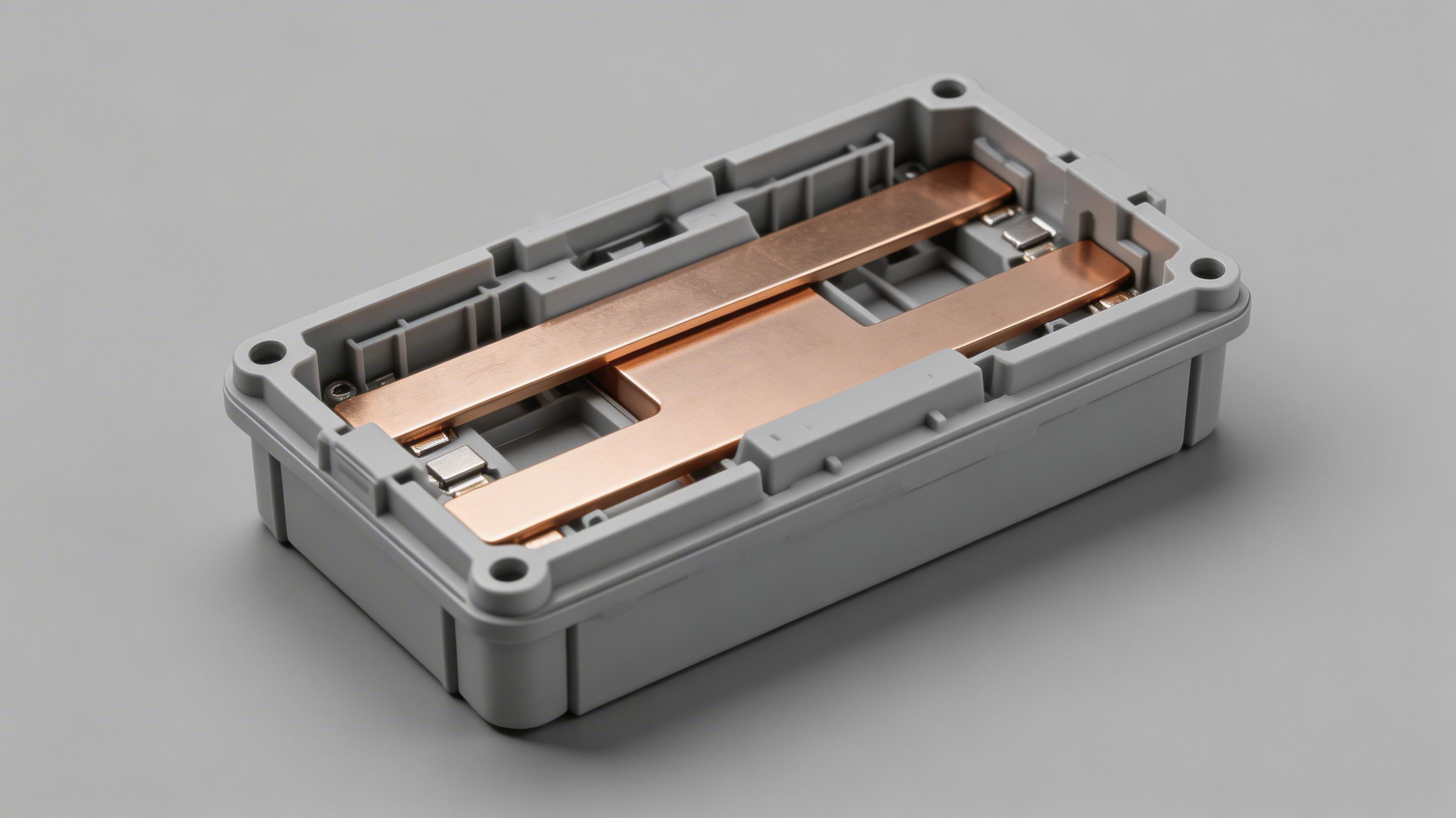
The electrification of the automotive industry demands power modules that are not only efficient but also compact and thermally robust. As electric vehicle (EV) inverters push toward higher switching frequencies and power densities, traditional assembly methods involving bolted connections and separate cooling units are reaching their limits. Insert molding has emerged as the critical manufacturing solution to address these challenges. By encapsulating metal components directly within high-performance thermoplastics, engineers can significantly reduce parasitic inductance and optimize thermal paths. Livepoint Tooling specializes in these advanced insert molding services, providing the OEM and ODM capabilities necessary to bridge the gap between complex design concepts and mass production realities.
Engineering High-Voltage Efficiency via Insert Molding
Integrating copper busbars and cooling structures directly into the housing through insert molding fundamentally alters the performance characteristics of a power module. This process moves beyond simple encasement to become a functional strategy for electrical and thermal optimization.
Minimizing Inductance with Integrated Busbars
In high-voltage EV traction inverters, stray inductance is a primary adversary, often leading to voltage spikes that threaten Silicon Carbide (SiC) or IGBT chips. Traditional manufacturing relies on bolted busbars, which introduce mechanical interfaces and extend the current loop area. By utilizing insert molding, engineers can embed heavy copper busbars directly into the plastic housing, eliminating the need for bulky fasteners and reducing the physical distance between components.
Historical data from power module development shows that replacing bolted terminals with molded, laminated busbar structures can reduce stray inductance by approximately 30% to 40%. For example, a standard bolted assembly might exhibit loop inductance in the range of 15–20 nH (nanohenries), whereas an optimized insert-molded design can push this figure below 10 nH. This reduction allows for faster switching speeds without exceeding voltage breakdown limits. Furthermore, the molding floor insert placement process utilizes automation to position these heavy copper elements with micron-level precision, ensuring that the critical distance between positive and negative terminals is minimized and consistent across every unit produced.
Optimizing Thermal Dissipation and Materials
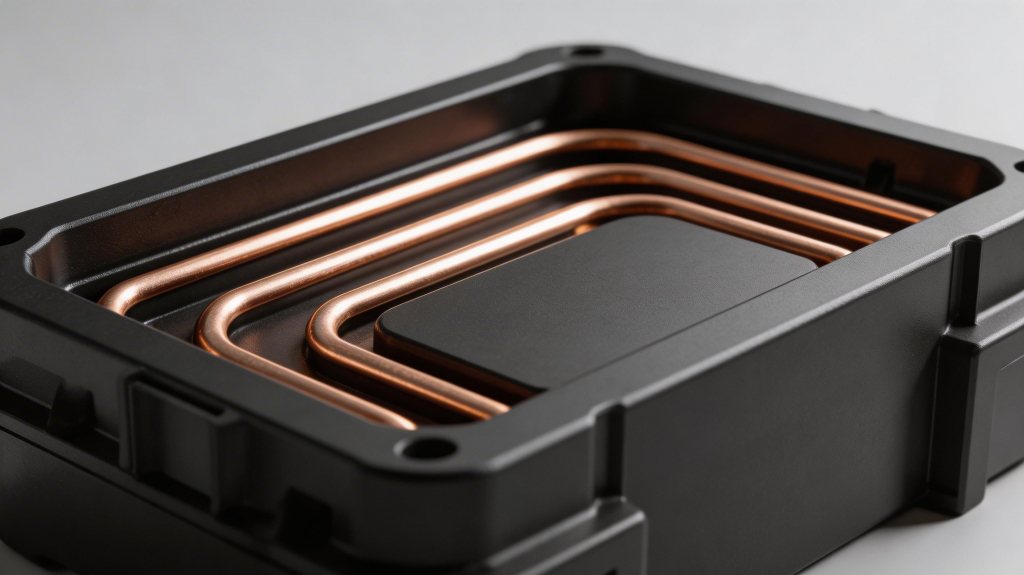
Thermal management is equally critical. As power density increases, the ability to move heat away from the die becomes the limiting factor for performance. Heat molded inserts—specifically designed metal substrates or cooling channels encapsulated in plastic—allow for more direct cooling pathways. Unlike traditional setups that rely on multiple layers of Thermal Interface Materials (TIMs), insert molding allows for the integration of liquid cooling pin-fin structures directly into the module housing.
Selecting the right polymer is essential for this hybrid structure. High-performance thermoplastics like PEEK (Polyether ether ketone) or PPS (Polyphenylene sulfide) are commonly used due to their high Continuous Use Temperature (CUT) often exceeding 200°C. However, the challenge lies in the Coefficient of Thermal Expansion (CTE). Copper has a CTE of roughly 17 ppm/°C, while standard thermoplastics can be significantly higher. A mismatch here leads to delamination or stress cracking during thermal cycling. By employing glass-fiber-reinforced PPS, manufacturers can tune the resin’s CTE to closely match that of the copper inserts, ensuring structural integrity over thousands of heating cycles. This precise material science reduces thermal resistance ($R_{th}$) by eliminating air gaps and maximizing the contact area between the heat source and the coolant.
Livepoint Tooling: Premier Insert Molding Capabilities
Livepoint Tooling (Livepoint Tooling) stands as a strategic partner for B2B clients in the automotive, medical, and industrial sectors, delivering high-precision insert molding solutions that adhere to rigorous quality standards.
Comprehensive Manufacturing Solutions
Livepoint Tooling offers a seamless transition from prototype to mass production, supporting complex geometries that standard molding cannot achieve. The company’s capabilities extend to handling various insert types, including threaded inserts, electrical contacts, and complex metal lead frames. By combining the metal and plastic steps into a single insert molding operation, Livepoint Tooling eliminates the need for secondary assembly and installation labor. This consolidation not only reduces manufacturing costs but also creates a stronger, more reliable bond between the material layers. Their facility is equipped to handle high-tonnage production, ensuring that even large-scale automotive power modules are produced with zero defects. Whether the requirement is for high-temperature thermoplastics or intricate overmolding of delicate electronic components, their engineering team provides Design for Manufacturability (DFM) analysis to optimize the mold flow and insert stability.
Quality Control and Material Expertise
Quality at Livepoint Tooling is governed by strict adherence to industry specifications. The company employs advanced validation techniques to ensure that every molded part meets the demanding requirements of EV applications. This includes monitoring injection pressures to prevent the deformation of sensitive metal inserts and utilizing high-grade materials that offer superior chemical and wear resistance. Their expertise ensures that the final product provides better component reliability compared to assembled parts, as the encapsulated inserts are protected from vibration, shock, and environmental corrosion.
Contact our engineering team today to evaluate your power module design and discover how our precision insert molding solutions can optimize your inductance and thermal performance.
