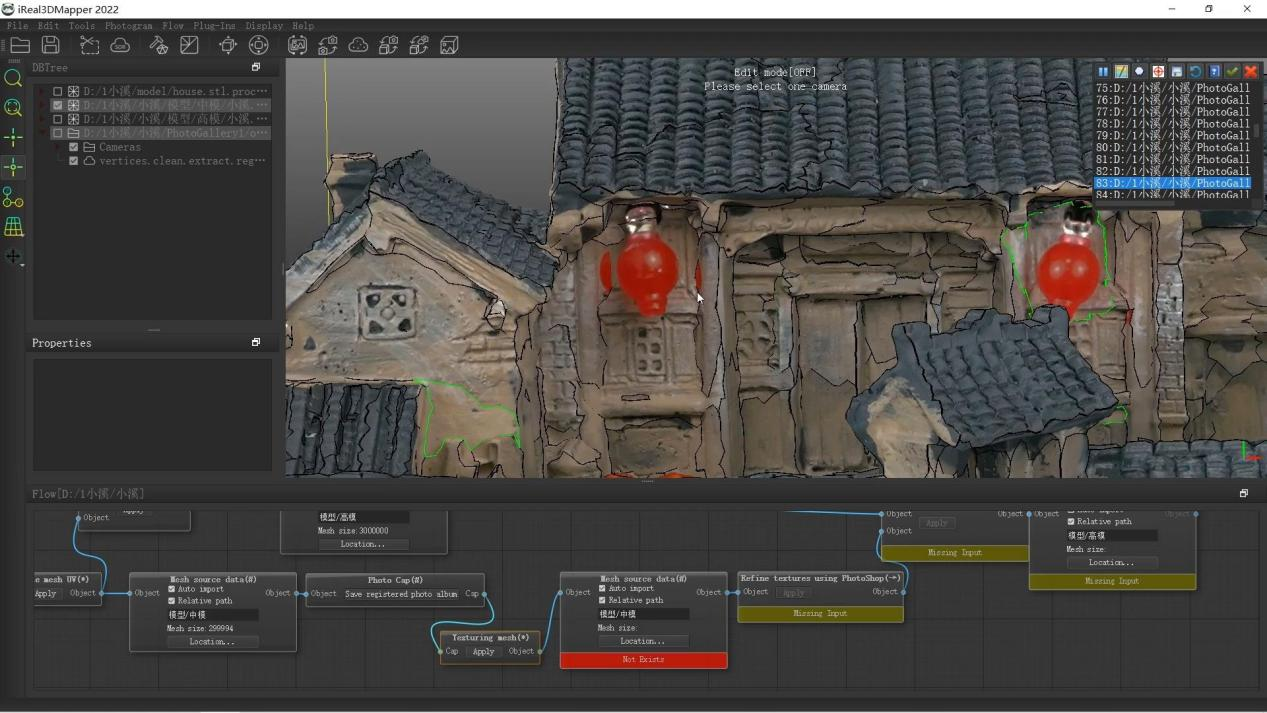
In the modern digital workflow, 3D mapping is the last and most important step that turns raw geometric data into a usable, photorealistic model. It is the process that puts together, improves, and finishes the data that a 3D scanner collects. When someone asks, “What software is used for 3D mapping?” they are really asking about specialized, high-performance platforms that focus on data fidelity and visual representation instead of data acquisition. Dedicated 3D mapping software, like the powerful tools in the 3DeVOK ecosystem, is at the forefront of this refinement stage. These tools are made to carefully handle complex meshes and apply high-resolution textures. This specialized software is necessary because scanners only capture millions of coordinate points. The processing engine is the only thing that can turn that data into a digital asset that is accurate and visually appealing, ready for professional use.
The Engine of 3D Mapping Software: From Point Cloud to Digital Mesh
The process starts with a point cloud that is dense and often noisy. The main job of 3D mapping software is to connect these points in a smart way to make a structured, watertight mesh, which is like a digital skin for the object. This “meshing” stage needs advanced algorithms to accurately triangulate points while closing gaps, filling holes, and reducing noise without changing the original dimensions. This kind of processing takes a lot of computing power, and it often needs optimized PC systems to work well and stay stable.
After the first meshing, the software does important geometric preparation. Tools for smoothing, filling holes, and decimation make the model better for use in CAD or animation software later on. For big projects that need a lot of scans, strong alignment is very important. 3DeVOK’s Hybrid Alignment mode makes this complicated stitching easier by using both object features and physical markers. This makes sure that all data is perfectly registered in a single coordinate system. This careful processing layer is necessary because it turns raw, messy scan data into a digital twin that makes sense and can be used.
The Role of 3D Texture Mapping Software in Achieving Photorealism
This type of software is categorized as 3D texture mapping software, responsible for projecting colors, materials, and visual details onto geometric meshes. While basic scans rely on the scanner’s built-in color data, applications such as museum archiving, virtual reality, and high-end product visualization require texture quality that matches the geometric precision.
This demand has spurred advanced features like Texture Mapping Replacement, which allows users to enhance or fully replace scanned textures with ultra-high-resolution DSLR photos. Intelligent mapping algorithms automatically align these external images with the 3D mesh, correcting lighting variations, lens distortion, and alignment issues to achieve DSLR-quality textures beyond the capability of geometry scanners alone.
The 3DeVOK platform enhances this process through specialized tools like its mapping software and BesTexture Plug-in, integrating optimal geometric detail with superior textures to create archival-quality digital twins. The final step generates optimized UV maps to ensure distortion-free texture wrapping, preparing models for export to game engines or visualization platforms.
Uses in the Workplace: Requirements for Driving Software
3D texture mapping software meets the demands of specialized professional applications. In cultural heritage and museum digitization, it enables non-contact creation of high-resolution digital artifacts for virtual display, research, and restoration planning, while precisely preserving both geometry and surface details such as paint cracks and wear patterns.
For virtual/augmented reality digital assets, the software must produce optimized models that maintain visual richness with low polygon counts for smooth real-time rendering. In architectural and industrial inspection, it processes large-scale environmental scans to generate “as-built” documentation, handling massive point clouds from LiDAR or structured light scanners for BIM integration, where dimensional accuracy and noise removal take priority over texture.
For digital human creation in film and gaming, the software must handle complex organic surfaces and subtle color gradients, seamlessly blending scanned geometry with photographic textures. The 3DeVOK system demonstrates its professional versatility by integrating diverse data types—from blue laser precision to infrared speckle capture and external DSLR imagery—within a unified software environment.
The Integrated 3DeVOK Workflow: The End
The best answer to the question of which software is used for 3D mapping is not one program, but a whole system where scanner hardware and specialized software work together. The scanner gets the raw points, but the advanced 3D Mapping Software turns these millions of useless points into smart, high-quality digital assets. The workflow needs to be very fast and reliable so that complicated tasks like Texture Mapping Replacement and multi-scan alignment can be done quickly and correctly. 3DeVOK meets this need by offering specialized tools made just for professional digitization. These tools include high-precision geometric processing and photorealistic 3D texture mapping software that can be used for anything from preserving cultural artifacts to advanced industrial visualization. This makes it a top choice for complete 3D data management.
