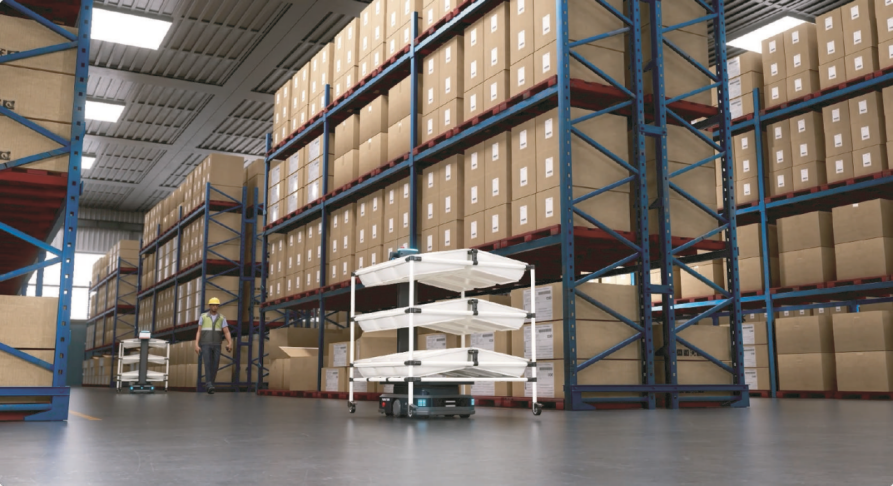
How follow-picking AMRs fit small and mid-sized 3PL warehouses that have outgrown manual carts but cannot yet justify goods-to-person.
May 25, 2026, Read Time: 11 min Read
Most US 3PL operators sit in an awkward middle zone of warehouse automation. Their order volumes have outgrown the manual pick-and-push model, but their site sizes, lease horizons, and SKU volatility do not yet justify a multi-million-dollar goods-to-person installation. The procurement question is no longer whether to automate picking. It is which lightweight model actually fits a 5,000 to 30,000 square foot warehouse with five to fifteen pickers, mixed cross-border e-commerce SKUs, and a three-year lease.
This guide is for warehouse operations managers, 3PL owners, and brand-side fulfillment leads evaluating that decision in 2026. It explains what assisted picking with follow robots actually looks like operationally, when it makes more sense than goods-to-person, and how to evaluate a vendor. A real deployment in a New Jersey 3PL warehouse, using PUDU T600 follow-picking robots and a PUDU MT1 for site housekeeping, anchors the buyer logic to a working site rather than a brochure.
Why small and mid-sized 3PL warehouses cannot justify goods-to-person yet
Goods-to-person systems, including shuttle ASRS and the AutoStore-style cube storage that drew most automation headlines in the last five years, were built for sites with stable SKU bases, multi-year tenancy, and order density measured in thousands of lines per hour. They work, but their fit is narrower than the marketing suggests.
For a typical US cross-border e-commerce 3PL, three constraints push against that model:
– Capex floor and contract length. A goods-to-person installation amortizes over five to seven years. Most 3PL leases run three to five years, and contract logistics customers can move accounts on shorter notice. The capex line item rarely clears the procurement committee.
– SKU volatility. Cross-border e-commerce inventory turns over fast and unpredictably. SKUs added today may be obsolete in two seasons. Goods-to-person grids reward stable SKU profiles. They penalize warehouses that need to re-slot frequently.
– Building constraints. Smaller warehouses often have low ceilings, mixed-shelf layouts, mezzanines, and pallet aisles that were never designed for high-bay automation. A retrofit for full goods-to-person can cost more than the equipment.
What is left is the broad middle: warehouses running 5 to 30 pickers across roughly 5,000 to 30,000 square feet, where the dominant labor cost is not picking accuracy. It is the time pickers spend walking, pushing carts, and returning to the packing area.
What assisted picking actually means operationally
Assisted picking with follow robots is a distinct automation model. It is not a stripped-down goods-to-person, and it is not just a self-driving cart. Three operational properties define it:
1. Robot follows the picker, not the other way around. The robot lifts a standard picking cart from below and shadows the human picker along the route the human chooses. The picker stays in charge of route, SKU lookup, and pick verification. The robot removes the cart-pushing and back-and-forth carrying.
2. One-tap return to packing. When the cart is full or the order set is complete, the picker sends the loaded cart back to the packing area with a single command. The picker continues working in the aisle. The robot returns autonomously while the next idle robot is called up.
3. Lightweight infrastructure. There is no shelving rebuild, no high-bay grid, no rail. Deployment typically only needs floor mapping, a charging station, and a tablet or app interface for the picker. This is the model that fits a 3,000 to 10,000 square foot picking zone in a leased warehouse.
The shorthand is sometimes called follow-me picking or lift-and-follow. The underlying robot is a low-profile autonomous mobile platform with a lifting deck, dual-wheel differential drive, and a fused VSLAM and LiDAR navigation stack so it can hold its lane in a warehouse aisle full of moving people and pallets.
Decision framework: when to choose assisted picking over goods-to-person
Procurement teams evaluating warehouse automation can use the following decision axes to choose between assisted picking and a heavier goods-to-person installation:
| Decision axis | Favors assisted picking (follow robots) | Favors goods-to-person (shuttle / cube) |
| Site size | 3,000 to 30,000 sq ft picking zone | 30,000+ sq ft with high-bay ceilings |
| Picker count | 3 to 20 full-time pickers | 30+ pickers, multi-shift |
| Order density | Variable; spikes during peak season | Consistently high lines per hour |
| SKU stability | High SKU churn, cross-border e-commerce profile | Stable SKU base, long product cycles |
| Lease horizon | 3 to 5 year lease, contract logistics | Owned or 7+ year tenancy |
| Building constraints | Low ceilings, mixed shelving, existing aisles | Greenfield or major retrofit acceptable |
| Time to first value | Weeks | Months to a year |
| Capex sensitivity | Need depreciation under the typical lease term | Capex amortizable over 5 to 7 years |
Figure 1. Decision axes for choosing assisted picking versus goods-to-person in small and mid-sized 3PL warehouses.
When most or all of the left column applies, assisted picking is the rational first automation step. It is also the model that lets a 3PL operator validate ROI on a small fleet before deciding whether a future site warrants a heavier system.
A real US deployment: a New Jersey cross-border e-commerce 3PL
A New Jersey-based cross-border e-commerce 3PL operator deployed five PUDU T600 follow-picking robots, paired with one PUDU MT1 for floor housekeeping, in a roughly 800 square meter (about 8,600 square foot) picking zone staffed by five full-time pickers. The operator serves cross-border e-commerce sellers, US-side brand fulfillment customers, and local distribution accounts. Daily operations cover inbound receiving, storage, order picking, packing, outbound shipping, and routine warehouse management.
Before automation, pickers spent a significant share of each shift on two activities that are not value-added: walking long distances between shelves, picking lanes, and packing stations, and pushing carts back and forth as orders filled. Multi-SKU orders with scattered pick paths made the problem worse.
The deployed workflow is straightforward enough to write on one whiteboard:
1. The picker manually loads a picking cart and parks it at a staging position.
2. PUDU T600 lifts the cart from below and follows the picker through the route.
3. Once the cart is full, the picker taps once on the interface to send the cart back to the packing area.
4. The picker calls the next idle PUDU T600 from the standby area through Pudulink, lifts the next cart, and continues.
5. PUDU MT1 runs autonomous floor cleaning on its own schedule around the picking workflow.
The operator was clear about what to call this and what not to call it. It is not a goods-to-person system. It is a lightweight automation layer that removes the cart-pushing and the back-and-forth walking from the picker’s day, so the picker can focus on locating items, picking accurately, and order verification.
Phase 2 of the project replicates the same fleet at the operator’s California warehouse at equivalent scale, with five PUDU T600 units and one PUDU MT1. The operator has also agreed to host site visits from other warehouses, which makes the site usable as a reference for similar 3PL and overseas-warehouse buyers in the US market.
What the robot actually does, in spec terms
The follow-picking workflow described above is enabled by a small number of capabilities. Buyers comparing assisted-picking platforms should check each of these against the vendor’s published specifications:
| Capability | What to look for | PUDU T600 |
| Payload | Enough margin for a loaded picking cart, typically 200 to 500 kg in 3PL | Up to 600 kg max load on the lifting deck |
| Navigation stack | Fused VSLAM and LiDAR for dynamic warehouse aisles | Laser SLAM plus VSLAM fusion |
| Lift mechanism | Underride lift compatible with standard picking carts | 30 mm underride clearance, 60 mm lift travel |
| Footprint | Narrow enough for tight aisles | 835 by 500 mm chassis |
| Drive and speed | Differential drive with smooth low-speed control | Dual-wheel differential, up to 1.2 m/s |
| Battery and uptime | Full-shift runtime plus a fast charge or swap option | About 6 hours full-load, 2 hour charge to 90%, swap supported |
| Safety | Multiple e-stops, front and rear LiDAR, audible cues | Three emergency stop switches, dual-direction LiDAR, stereo audio |
| Software | Fleet scheduling, idle-robot call, open API | Pudulink fleet control and Pudu Cloud open API |
Figure 2. Capability checklist for an assisted-picking AMR, with the PUDU T600 specifications from the published industrial product brochure.
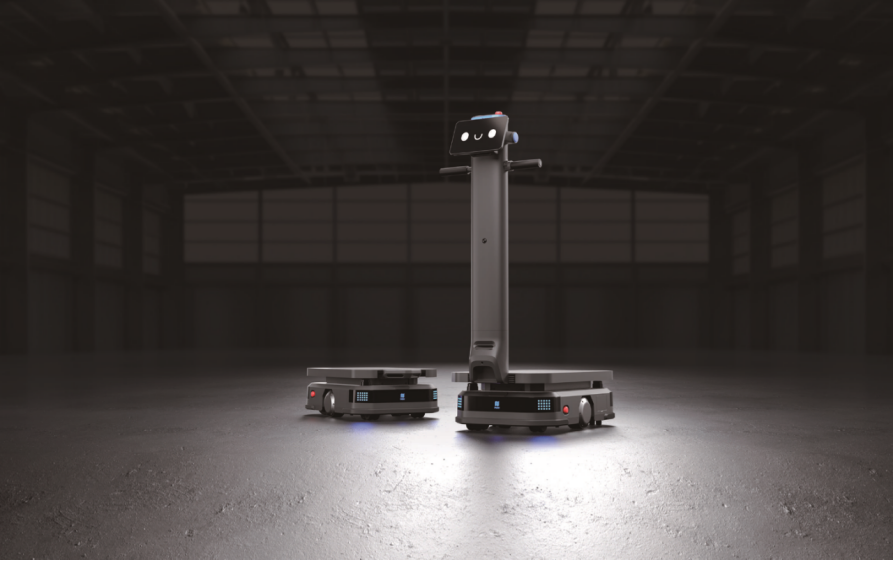
Figure 3. PUDU T600 (left, underride variant; right, standard with operator display) on an industrial warehouse floor.
A note on the cleaning robot in the deployment. The PUDU MT1 in this site is not part of the picking workflow itself. It is the floor housekeeping layer that keeps the picking aisles and packing zone clean while the T600 fleet runs. For 3PL warehouses that already have a floor cleaning vendor under contract, this layer is optional rather than mandatory.
Where Pudu Robotics fits in the small and mid-sized 3PL segment
Buyer questions in this segment usually narrow to three: is the vendor going to be around in five years, does the product line cover the use cases the operator will add later, and is there evidence the platform works in similar sites.
On the first question, Pudu Robotics ranked first globally in commercial service robotics by 2023 revenue share, with 23 percent of the market, according to Frost & Sullivan’s Market Research on Global Commercial Service Robotics (2023). Category leadership at that scale gives a 3PL operator confidence on supply continuity, spare parts availability, and roadmap investment.
On the second question, the same vendor supplies an industrial delivery line that scales beyond assisted picking. The PUDU T300 covers 300 kg payload tasks with modular tops including conveyor, towing, lift, and multi-layer pallet, and the PUDU T600 covers 600 kg pallet-ready transport. A 3PL operator that starts on assisted picking has a defined upgrade path to towing, conveyor handoff, and pallet movement without changing vendor. The PUDU MT1 covers the commercial cleaning side of the same site.
On the third question, the New Jersey deployment is one current US reference, and Phase 2 in California is planned at the same fleet size. For buyers in similar segments, that is the proof point that matters: a working site at comparable scale, with an end user willing to host walk-throughs.
What to evaluate before a pilot
A 30 to 90 day pilot is the standard procurement next step for assisted picking. Before signing the pilot scope, evaluate the following against the candidate vendor:
– Cart compatibility. Does the robot lift the picking carts already in the warehouse, or does the operator need to standardize on a new cart spec?
– Aisle width and turning. Run the robot through the tightest aisle in the building, not the showroom aisle.
– Pick-path interaction. How does the robot handle the human picker stopping, reversing, or stepping away to scan a SKU? How quickly does it re-acquire the picker?
– Fleet behavior. With five robots in the building, what does the standby and call-up logic look like during a peak hour? Is there a queue? Is there blocking at the packing area?
– Service and parts. Where is the nearest authorized service partner? What is the spare parts lead time? Is there a US-based depot?
– Software integration. Is there an open API to call from the warehouse management system, or only a vendor-controlled fleet manager?
– Operator interface. Can a new picker be productive on the interface within one shift, or does it require formal training?
Most of these can be answered in a one-week site survey. None of them require a multi-month feasibility study.
FAQ
Is assisted picking a real automation step, or just a cart with wheels?
It is a real automation step. The follow robot removes the cart-pushing and the back-and-forth walking from the picker’s day, which is a measurable share of shift time in most 3PL warehouses. It does not automate SKU lookup or pick verification, and it is not marketed as goods-to-person. The procurement test is whether walking and cart handling are a meaningful portion of picker time at your site. If they are, the productivity case is straightforward.
How big does a 3PL warehouse need to be to justify follow robots?
There is no hard floor, but in practice the model works well from about 3,000 square feet of active picking zone and 3 to 5 full-time pickers upward. Below that, a single picker can usually walk the floor without the productivity loss being significant. Above 30,000 square feet with 30+ pickers, the buyer should also compare against a partial goods-to-person installation.
What is the difference between assisted picking and goods-to-person?
Assisted picking keeps the human picker at the shelf and uses a robot to carry the cart. Goods-to-person brings the shelf to the human picker, who stays at a fixed station. Assisted picking has a much lower infrastructure footprint and shorter deploy time. Goods-to-person has higher peak throughput in the right site shape. They are not interchangeable, and many operators run both: assisted picking in older or short-lease sites, goods-to-person in newer high-density sites.
What payload class should a 3PL operator buy?
For e-commerce picking carts loaded with parcels and totes, 300 kg is usually sufficient and gives PUDU T300 enough margin. For larger picking carts, pallet movement between stations, or replenishment from reserve storage, 600 kg with a PUDU T600 gives more headroom and covers a wider range of secondary tasks without a second platform.
How long does a follow-picking deployment take in a small 3PL warehouse?
Most lightweight assisted-picking deployments in the 5,000 to 15,000 square foot range can be live within a few weeks. Mapping, charging station placement, picker training, and an initial supervised week is a typical scope. This is one of the main reasons the model fits short-lease warehouses where a six-month integration project is not viable.
Conclusion: the lightweight automation step most US 3PLs should evaluate first
The gap between manual picking and goods-to-person is where most US 3PL warehouses actually live. Assisted picking with follow robots is the automation model designed for that gap. It removes the cart pushing and walking that consume the largest non-value-added share of picker time, it deploys in weeks, and it does not lock the operator into a multi-year capex contract that exceeds the lease horizon.
For a 3PL operator running a 5,000 to 30,000 square foot picking zone, the practical next step is to scope a 30 to 90 day pilot on a single aisle, using the evaluation checklist above. Pudu Robotics supplies the product line that covers this segment today, with the PUDU T600 for assisted picking, the PUDU T300 for lighter payload tasks, and the PUDU MT1 for floor housekeeping, alongside a current US reference deployment that is open to site visits.
References & Further Reading
1. Frost & Sullivan, Market Research on Global Commercial Service Robotics (2023). https://www.frost.com/
2. Pudu Robotics, Industrial Product Brochure V1.1 (April 2026), PUDU T300, T600, and T600 Underride specifications.
3. Pudu Robotics, PUDU T600 product page.
4. Pudu Robotics, PUDU T300 product page.
5. Pudu Robotics, PUDU MT1 product page.
6. Pudu Robotics, company and solutions overview.
