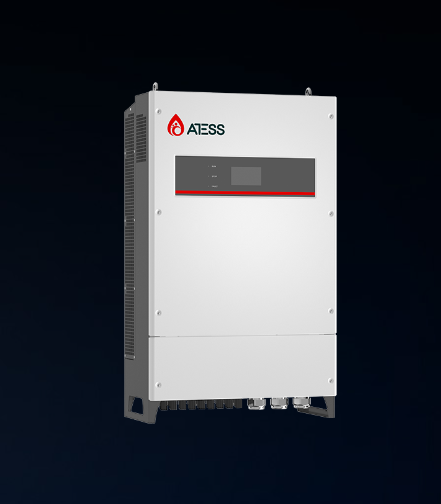
Across commercial and industrial energy projects, the role of a hybrid inverter continues to expand as businesses seek greater flexibility in power management. Atess develops integrated energy storage solutions that combine photovoltaic generation, battery storage, and grid interaction within a single platform. According to information provided by Atess, their all-in-one systems are available from 5kW to 150kW, supporting a wide range of energy applications from small commercial sites to larger industrial facilities.
How a Hybrid Inverter Supports Energy Management
A hybrid inverter serves as the central control point between solar panels, batteries, utility grids, and electrical loads. Atess states that these systems can convert DC electricity from solar panels into AC power while also managing battery charging and discharging. The equipment automatically directs energy where it is needed based on system settings and power availability.
For facilities that require backup power, Atess products support on-grid and off-grid operation. Their systems can switch to off-grid mode within 10 milliseconds during a grid failure, helping maintain power continuity for connected loads.
Features of Hybrid Inverters for Solar Applications
Many organizations evaluating hybrid inverters for solar projects look for solutions that can handle multiple energy sources within one system. Atess offers products that support battery, load, grid, and solar connections in a single unit. Several models also include programmable working modes for peak-shaving, backup power, and self-consumption strategies.
The company’s commercial product range includes systems from 30kW to 150kW, with some models supporting up to 600kW of total system capacity. Certain high-voltage models feature multiple MPPTs, battery voltage ranges up to 900V, and PV voltages up to 1500VDC, helping accommodate larger installations.
Why Hybrid Inverters for Solar Are Used in Different Industries
The demand for hybrid inverters for solar systems extends across factories, office buildings, shopping centers, farms, and remote sites. Atess notes that these systems can help reduce peak demand charges, provide backup power, and support energy independence through integrated solar and battery management.
Their solutions are also designed to support flexible configurations, allowing project developers to adapt system designs according to operational requirements and available energy resources. This adaptability makes a hybrid inverter suitable for both grid-connected and off-grid installations.
As solar and energy storage projects become more common, hybrid inverters for solar systems play an important role in coordinating energy generation, storage, and consumption. Atess provides integrated solutions ranging from 5kW to 150kW, with features that support backup power, grid interaction, and energy management. For commercial and industrial users, a hybrid inverter can provide a practical way to manage multiple power sources within a unified system.
