Commercial rooftop solar projects require more than enough PV capacity to meet annual energy targets. The inverter must also handle the site’s peak electrical demand, battery charging and discharging, grid interaction, backup loads, and the physical conditions of the installation. For businesses planning solar-plus-storage, understanding how does a hybrid inverter work is an important first step toward selecting an appropriately sized system.
A hybrid inverter combines power-conversion and energy-management functions for PV, batteries, and AC loads. Unlike a conventional PV inverter, a properly configured hybrid system can coordinate solar generation and battery storage while supporting both grid-connected and backup operation. The U.S. Department of Energy explains that solar-plus-storage systems can use advanced inverters to continue supplying selected loads during grid outages when the system is designed for that purpose.
Start With the Commercial Load Profile
The first sizing step is understanding how the building consumes electricity. Annual energy consumption is useful for estimating the potential value of solar generation, but inverter sizing depends heavily on instantaneous and recurring loads.
Engineers should examine peak demand, typical daytime consumption, critical loads, operating schedules, and seasonal variations. A manufacturing facility operating multiple motors may have a very different electrical profile from an office building or retail property.
The battery should also be evaluated separately from the PV array when determining its required power and energy capacity. A project may need enough battery power to support selected critical loads, reduce demand peaks, or shift solar energy into higher-cost periods. These objectives can lead to different inverter and battery configurations.
How Does a Hybrid Inverter Work?
A hybrid inverter manages energy flows between the PV array, battery, utility grid, and connected loads. During normal operation, PV electricity can supply the building directly, charge the battery, or be exported according to the system’s control strategy.
When solar production falls, stored battery energy can be converted back into AC electricity for the building. If the grid fails and backup operation is supported, the inverter can establish the appropriate electrical conditions for designated loads and isolate them from the utility grid.
The U.S. Department of Energy notes that a DC-coupled solar-plus-storage system can use a bidirectional inverter to connect battery storage directly with the PV array, while AC-coupled systems use separate conversion paths.
Match Inverter Output to the Site’s Power Requirement
The inverter’s AC output rating should be selected according to the intended operating requirement rather than simply matching the nameplate capacity of the PV modules.
For example, a commercial rooftop could have a 200 kWp PV array but require considerably less instantaneous AC output under normal conditions. Conversely, a facility with high peak demand and substantial critical loads may require a larger inverter even when its PV array is relatively modest.
Designers should therefore distinguish between PV capacity, inverter AC capacity, battery power capacity, and critical-load capacity. These values influence each other but should not automatically be treated as identical.
Consider PV-to-Inverter Sizing and MPPT Requirements
The PV side introduces another important consideration: array configuration. Different roof orientations, tilt angles, shading conditions, and string lengths can create different operating characteristics across the array.
Multiple maximum power point tracking (MPPT) inputs can help manage these differences by allowing separate PV sections to operate at their appropriate voltage and current conditions. The U.S. Department of Energy notes that inverter selection and PV system configuration influence how effectively a solar installation converts and delivers generated electricity.
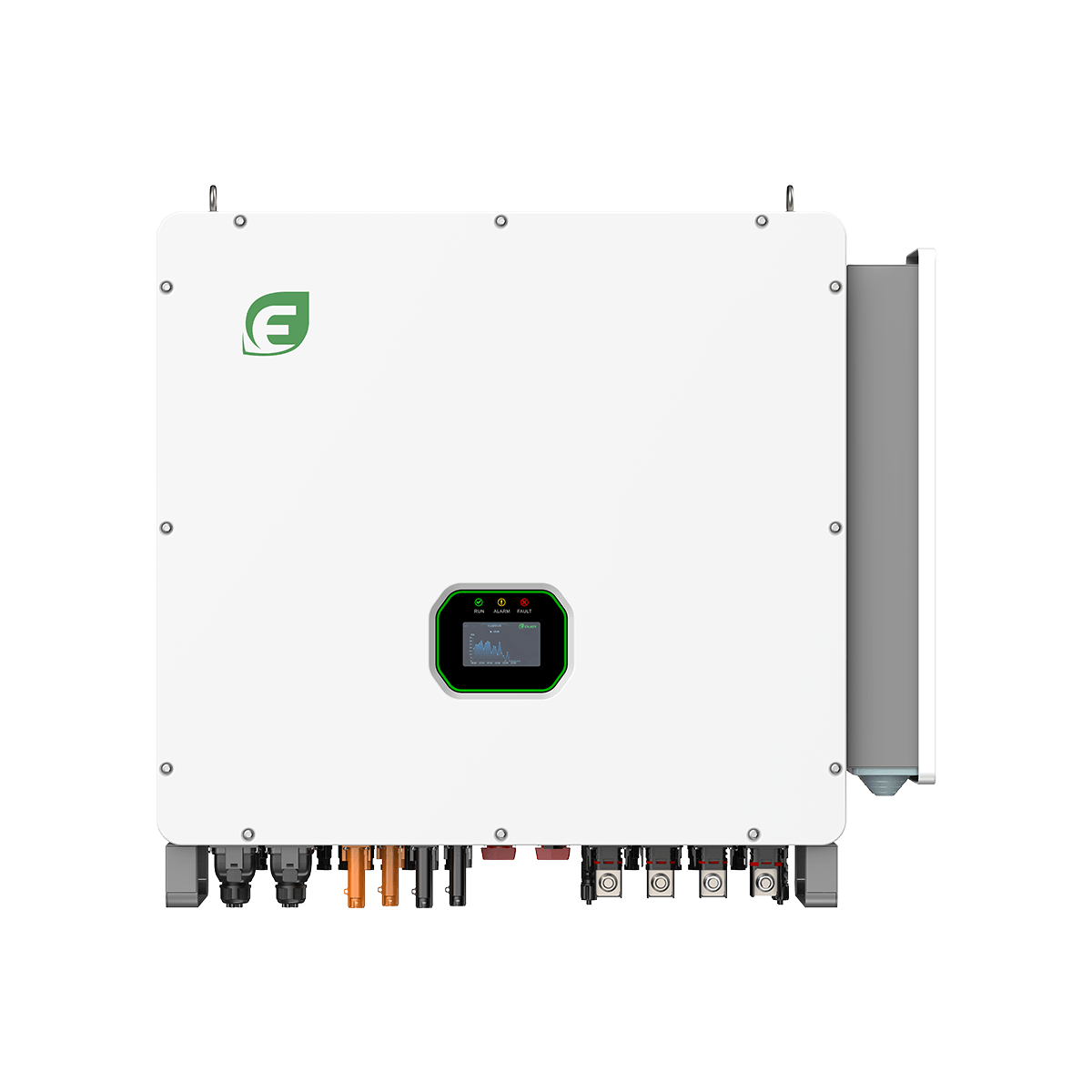
Enjoypowers’ 75–125 kW IP66 hybrid inverter provides 10 independent MPPT trackers. The product page specifies a maximum PV input current of 42 A × 10 and PV capacity of up to 250 kWp for the product family.
Size for Battery Voltage and Backup Loads
Battery selection cannot be separated from hybrid inverter selection. The inverter must operate within the battery’s voltage and current range while providing the required charging and discharging power.
Enjoypowers specifies a 180–950 Vdc battery voltage range for its 125 kW hybrid inverter, covering LFP, NMC, and sodium-ion battery configurations. Its rated on-grid and off-grid AC output is 125 kW, with a rated AC voltage of 400 V, three-phase, 3P+N+PE.
For backup applications, engineers should calculate the actual critical-load requirement rather than assuming the entire building must remain energized. Separating essential loads can reduce required battery and inverter capacity and may simplify the backup distribution architecture.
Outdoor Installation Changes the Equipment Specification
Commercial rooftops expose electrical equipment to environmental conditions that may not exist in an indoor electrical room. Temperature, moisture, dust, and installation space should therefore be included in equipment selection.
The Enjoypowers 75–125 kW hybrid inverter has an IP66 enclosure rating for outdoor wall or pad mounting. The 125 kW model is specified for operation from −40°C to 60°C, with derating above 50°C. Its maximum efficiency is 97.8%, based on the manufacturer’s published specifications.
These specifications can be particularly relevant when evaluating equipment for rooftops where dedicated indoor inverter rooms are impractical.
Account for Backup Transfer Requirements
Backup performance is another factor that can influence inverter selection. A commercial facility may have sensitive servers, control systems, production equipment, refrigeration, or other loads that cannot tolerate prolonged interruptions.
Enjoypowers specifies a transfer time below 10 ms for grid-to-off-grid and off-grid-to-grid operation on its 125 kW hybrid inverter. The manufacturer positions the system for critical-load applications where rapid transition is required.
This does not mean every commercial load requires the same transfer performance. Project engineers should determine the tolerance of each critical load and coordinate the inverter with UPS systems, protection devices, and the facility’s backup architecture.
Evaluate Hybrid Inverter Manufacturers in China on More Than Price
For buyers researching hybrid inverter manufacturers in China, technical evaluation should extend beyond the headline power rating. Product architecture, certifications, environmental specifications, MPPT configuration, battery compatibility, communications, control functions, service support, and documented test performance can all affect project risk.
Enjoypowers’ hybrid inverter integrates PCS, DC-DC conversion, MPPT, static transfer switching, and EMS functions into one outdoor enclosure. The company positions the 75–125 kW platform for commercial PV plants, microgrids, and harsh-environment deployments.
An integrated architecture can potentially reduce the number of separate cabinets and interfaces that an EPC contractor must coordinate, although the overall project design still needs to account for local electrical codes and interconnection requirements.
Build the Sizing Decision Around the Whole System
The right hybrid inverter size emerges from the relationship between PV capacity, site demand, battery voltage and power, critical loads, grid requirements, and the intended operating strategy. Simply matching inverter capacity to the PV nameplate can overlook important aspects of commercial solar-plus-storage design.
For project developers and EPC teams, the most useful approach is to model real load data and define the required operating modes before selecting equipment. With its 75–125 kW range, up to 250 kWp PV input, 10 independent MPPT trackers, 180–950 Vdc battery range, IP66 outdoor protection, and sub-10 ms transfer specification, Enjoypowers‘ platform provides a concrete architecture for evaluating commercial rooftop PV-plus-storage applications.
A properly sized hybrid inverter should ultimately support the project’s economics and electrical objectives without creating unnecessary conversion capacity. That makes detailed load analysis, PV configuration, battery requirements, and backup priorities the foundation of a reliable commercial solar design.
