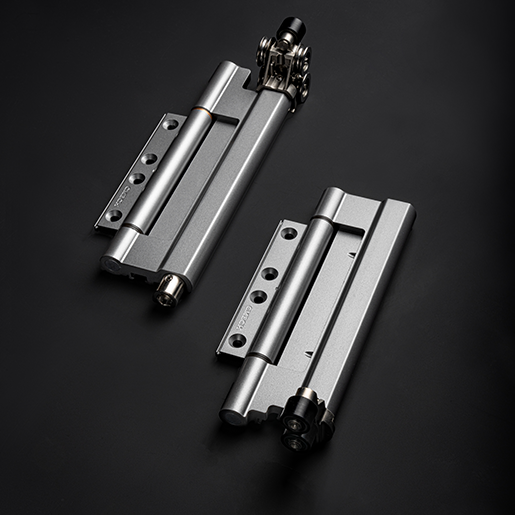
The difference between standard and heavy-duty bifold door hardware is not simply a matter of choosing a stronger-looking component. Panel weight, sash dimensions, the number of folding leaves, and the way the system distributes loads all influence the appropriate specification. Hardware that falls short of a door’s requirements may affect alignment and movement, while an unnecessarily high load rating may not offer practical value if the rest of the configuration is unsuitable. CMECH provides bi-folding door systems with different load-bearing capacities, giving fabricators and project teams a factual starting point for comparing options.
Start With the Weight of Each Door Panel
Panel weight is one of the first measurements to establish when selecting bifold door hardware. The completed sash—not just its frame—determines the load the hardware must support. Glazing, panel materials, and other incorporated components all contribute to the final weight.
CMECH’s Bi-Folding Door Hardware Series specifies a maximum load-bearing capacity of 120 kg per single sash. Its Even Configuration supports a maximum load of 150 kg, with an applicable sash width of 500–900 mm and sash height of 1,900–3,500 mm. These published ratings provide a useful distinction when assessing whether a project may need a higher-capacity configuration.
The two ratings should not be treated as interchangeable specifications for identical assemblies. Each belongs to a particular hardware configuration, and the selected system must also suit the door’s dimensions and panel arrangement. For project teams comparing standard and heavy-duty options, the first step is to calculate or confirm the completed panel weight, then compare it with the capacity of the intended system.
What Higher Load Capacity Means in Practice
A higher load rating gives a project more capacity for supporting a heavier sash within the specified range. It does not, by itself, establish that a hardware system will perform better in every application. Panel geometry, installation accuracy, component compatibility, and adjustment requirements remain important.
For applications that call for bifold door hardware heavy duty, CMECH’s Even Configuration offers a stated load-bearing capacity of up to 150 kg. Its modular design supports even-numbered leaf arrangements, while coordinated rollers, hinges, multi-point locks, and shootbolts help manage panel movement and alignment.
The upper and lower rollers use a dual-guide-wheel design to support controlled tracking. The lower roller also provides vertical adjustment from -1.5 mm to +3 mm, helping installers fine-tune panel positioning. Its one-piece, investment-cast 304 stainless steel construction is intended to combine structural strength with wear resistance.
These features matter because supporting a heavy panel involves more than meeting a numerical weight threshold. The hardware must guide the door through its folding movement while allowing the assembled leaves to align correctly.
Standard and Heavy-Duty Systems Are Not Defined by Weight Alone
The terms standard and heavy-duty are useful comparison labels, but they do not replace a manufacturer’s specific ratings. CMECH identifies different capacities for its Bi-Folding Door Hardware Series and Even Configuration rather than defining every application through a universal standard-versus-heavy-duty classification.
The Bi-Folding Door Hardware Series supports sashes up to 120 kg and covers sash widths of 500–900 mm and heights of 1,900–3,500 mm. Its system includes adjustable upper and lower rollers and hinges to help maintain panel balance and clearance. The system’s stated durability exceeds 30,000 operating cycles.
By comparison, CMECH’s Even Configuration provides a load-bearing rating of up to 150 kg and also specifies durability exceeding 30,000 cycles. Both configurations are designed around coordinated components, but the higher capacity of the Even Configuration may make it relevant to projects with heavier panels, provided the other application requirements are met.
When evaluating bifold door hardware heavy duty, project teams should therefore compare the complete specification, not just the maximum weight. Panel width, height, leaf count, roller arrangement, and the required folding layout all affect suitability. A higher capacity should be selected because the project requires it, not simply because the number is larger.
Match the Hardware to the Folding Configuration
The number and arrangement of leaves influence how a bifold door opens and how its panels move together. CMECH’s Even Configuration is designed for even-numbered leaf arrangements, while its Odd Configuration is designed for odd-numbered panel setups. The Odd Configuration is available with 120 kg or 150 kg load ratings.
This distinction is important when selecting bifold door hardware for a project with a specific opening layout. A capacity rating alone does not confirm that a system suits the intended number of leaves. Fabricators should identify the panel arrangement early and verify that the selected configuration supports it.
Hinges and locking components also contribute to the overall assembly. CMECH’s Even Configuration combines adjustable rollers and hinges for panel alignment with multi-point locks and shootbolts for securing the closed door. These components work together as an integrated hardware system.
CMECH’s configuration options allow panel count and load capacity to be considered together. This is particularly relevant for larger folding openings, where several leaves must move and close in a coordinated manner.
A Practical Checklist Before Specifying Hardware
Before confirming an order, project teams should document the completed sash weight, width, height, and number of leaves. These measurements should then be checked against the applicable capacity and dimensional range for the selected system.
The intended opening arrangement should also be confirmed. Even- and odd-numbered configurations are not interchangeable simply because they share a similar load rating. Installers and fabricators should additionally review roller adjustment, hinge compatibility, locking components, and the fixing conditions required by the door assembly.
For projects requiring bifold door hardware heavy duty, CMECH’s 150 kg Even Configuration provides one option to evaluate when the panel weight and folding layout fall within its specified range. Lighter applications may be adequately served by a system rated for up to 120 kg, subject to the same dimensional and configuration checks.
Choosing between standard and higher-capacity hardware ultimately comes down to matching the actual door to a documented system. By checking panel weight alongside dimensions, leaf arrangement, and component compatibility, project teams can select CMECH hardware on the basis of the application’s requirements rather than capacity alone.
