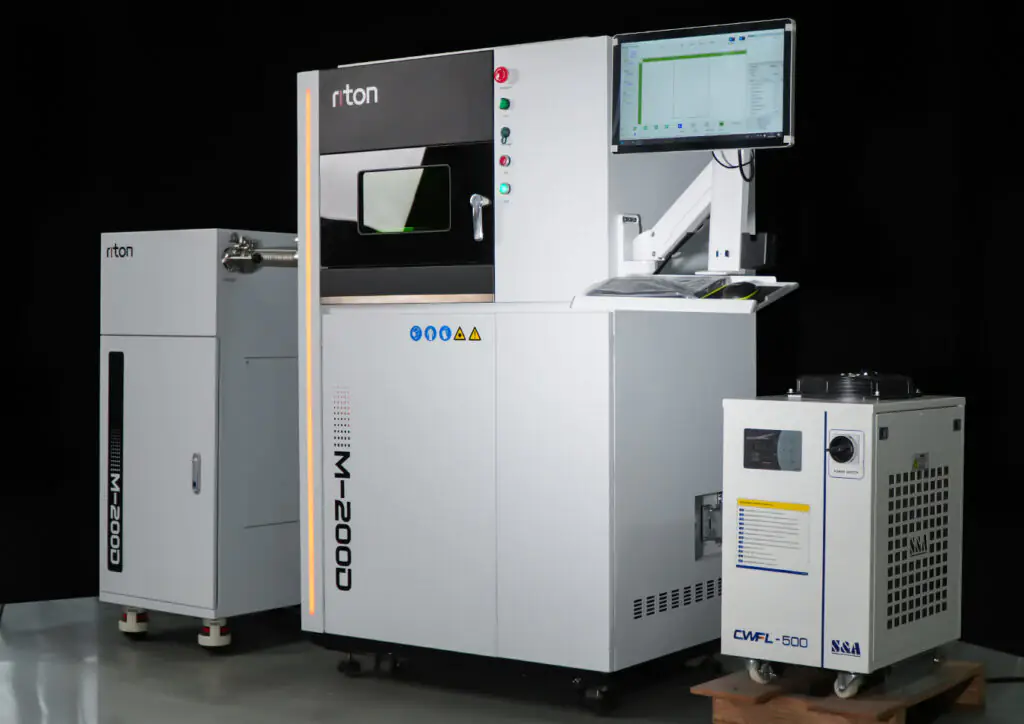
Choosing an SLM 3D metal printer is a strategic decision for businesses moving metal production toward digital manufacturing. Beyond purchase price, buyers need to evaluate build volume, laser configuration, material compatibility, process control, software, powder handling, maintenance, and production efficiency. For dental laboratories and manufacturers, these factors directly influence throughput, consistency, labor requirements, and the cost of each finished component.
Understand What SLM Technology Actually Requires
Selective Laser Melting (SLM) is a metal additive manufacturing approach within powder bed fusion. ISO/ASTM 52900 defines powder bed fusion as an additive manufacturing process in which thermal energy selectively fuses regions of a powder bed. NIST similarly describes powder bed fusion as melting and fusing successive layers of powdered material using a high-power laser or electron beam.
For buyers, this means the printer should not be judged only by its headline laser power. Powder spreading, layer thickness, atmosphere control, scanning strategy, and process monitoring all contribute to the final result. A technically impressive laser system can still deliver inconsistent production if the surrounding process is poorly controlled.
Evaluate Melting Area and Production Capacity
Melting area should match the actual production mix rather than simply being as large as possible. A larger platform can allow more parts to be nested in one build, potentially improving machine utilization. However, buyers should also consider how efficiently the available space can be used for their typical component sizes and quantities.
The Riton M-200D, for example, has a melting area of 220 × 150 × 140 mm, including the build platform. Its manufacturer specifies production of up to 430 crowns or 35 partial frames in 5.5 hours under ideal stated production-layout conditions.
This type of production information is more useful than build dimensions alone. Business buyers should compare expected parts per build, cycle time, material consumption, and post-processing workload before calculating potential return on investment.
What to Look for in an SLM 3D Metal Printer
Laser configuration is another important purchasing criterion. The M-200D uses double fiber lasers, with each laser rated at up to 500 W, a wavelength of 1.064 μm, and a maximum melting speed of 14,000 mm/s. Its specified layer thickness is adjustable from 20–60 μm.
These specifications should be considered together rather than separately. More laser power does not automatically mean better production. Buyers should ask how the laser configuration interacts with scanning strategies, powder characteristics, layer thickness, and the materials intended for production.
For dental applications, this is particularly relevant because laboratories may need repeatable production of crowns, partial frameworks, and other metal components rather than occasional prototypes.
Check Material and Atmosphere Requirements
Material compatibility is a fundamental selection criterion. SLM systems process metal powders under controlled conditions, and the required atmosphere depends on the material and process. Riton lists nitrogen or argon as protective gases for the M-200D.
Buyers should therefore examine more than a machine’s material list. They should verify supported powder specifications, gas requirements, powder recovery procedures, storage requirements, and whether different materials require dedicated handling procedures.
Riton also provides metal materials including CoCr and titanium-alloy material options for its dental 3D printing ecosystem. Its technical support guidance highlights that titanium production can involve specific gas, filtration, powder handling, and safety requirements.
Prioritize Monitoring, Software, and Process Control
Modern production environments increasingly require more than manual machine operation. Software can influence workflow efficiency by supporting job preparation, monitoring, process management, and production traceability.
Riton positions its metal printing portfolio around specialized control software and digital dental workflows. Its M-200D is promoted with smart control software, while Riton also offers specialized software resources for metal 3D printing.
For businesses comparing metal 3D printer manufacturers, it is worth asking whether the software supports the entire workflow or merely machine operation. Live monitoring and flaw detection can also provide valuable visibility during production, particularly when consistency and repeatability are important.
Consider Filtration, Maintenance, and Operating Costs
A printer’s purchase price represents only part of its total cost of ownership. Filters, protective gases, powder handling, maintenance, electricity, labor, and post-processing can significantly affect long-term production costs.
The M-200D incorporates a permanent filter with back-blowing, which Riton presents as a feature designed to help reduce production costs. The system is also designed around a cleaner printing environment and automated process features.
Maintenance requirements should be reviewed before purchase. Buyers should ask about filter cleaning, powder recovery, required auxiliary equipment, service intervals, installation conditions, and technician support. Riton, for example, provides installation consulting, training, on-site installation, and technical support services for its equipment.
Compare Metal 3D Printer Manufacturers Beyond the Machine
The manufacturer matters as much as the printer specification sheet. A reliable supplier should demonstrate experience in the intended application, provide technical documentation, support material development, and offer assistance throughout installation and production.
For dental businesses, Riton is positioned specifically around dental 3D printing solutions. Its metal printer portfolio is designed for dental applications, while its broader ecosystem includes metal materials, resin printers, auxiliary equipment, and digital software.
This application-specific approach can be valuable for companies that want to build a complete production workflow rather than purchase a standalone machine.
Make the Final Decision Based on Production Economics
The best SLM 3D metal printer is not necessarily the machine with the largest build area or highest advertised laser power. Buyers should compare measurable business outcomes: parts per build, cycle time, usable melting area, material utilization, labor requirements, maintenance costs, quality consistency, and available technical support.
For dental laboratories, Riton’s M-200D offers a relevant example of how these factors can be combined. Its dual-fiber-laser configuration, 220 × 150 × 140 mm melting area (including the build platform), 20–60 μm layer thickness, and stated dental production capacity provide concrete criteria for evaluating whether its configuration matches a laboratory’s workload.
Choosing for Long-Term Production Value
Selecting an SLM 3D metal printer should ultimately be treated as a production-system decision rather than a simple equipment purchase. Businesses should assess the complete workflow from digital design and powder management to printing, monitoring, post-processing, maintenance, and technical support.
For companies seeking dental-focused metal additive manufacturing, Selecting an SLM 3D metal printer should ultimately be treated as a production-system decision rather than a simple equipment purchase. Businesses should assess the complete workflow from digital design and powder management to printing, monitoring, post-processing, maintenance, and technical support.
For companies seeking dental-focused metal additive manufacturing, Riton.’s M-200D is an example of an application-oriented approach. A careful comparison of these factors can help business buyers select equipment that fits current production requirements while providing a practical foundation for future capacity expansion.
