Educational institutions and medical facilities require stable indoor environments because these buildings accommodate large numbers of people throughout the day. Rather than relying on periodic manual checks, they recommend establishing a continuous monitoring network that can collect environmental information from multiple indoor locations. HKT LORA’s LoRaWAN Indoor Air Quality Sensor is designed to work with standard LoRaWAN gateways and cloud platforms, helping customers build practical indoor monitoring systems while simplifying deployment and daily management.
Planning an air quality sensor Deployment Before Installation
A successful monitoring project begins with understanding how each building is used instead of determining the number of devices first. Classrooms, libraries, laboratories, consultation rooms, waiting areas, administrative offices, and other indoor spaces often experience different environmental conditions because their occupancy and daily activities are not the same. They recommend dividing the building into monitoring zones before installation so that every sensing point contributes meaningful environmental information to the overall monitoring system.
Planning the deployment in advance also makes future expansion easier. Since the solution is based on the LoRaWAN standard, additional monitoring locations can be incorporated into the same wireless network without changing the overall communication architecture.
Selecting Environmental Parameters for Different Indoor Applications Using an air quality sensor
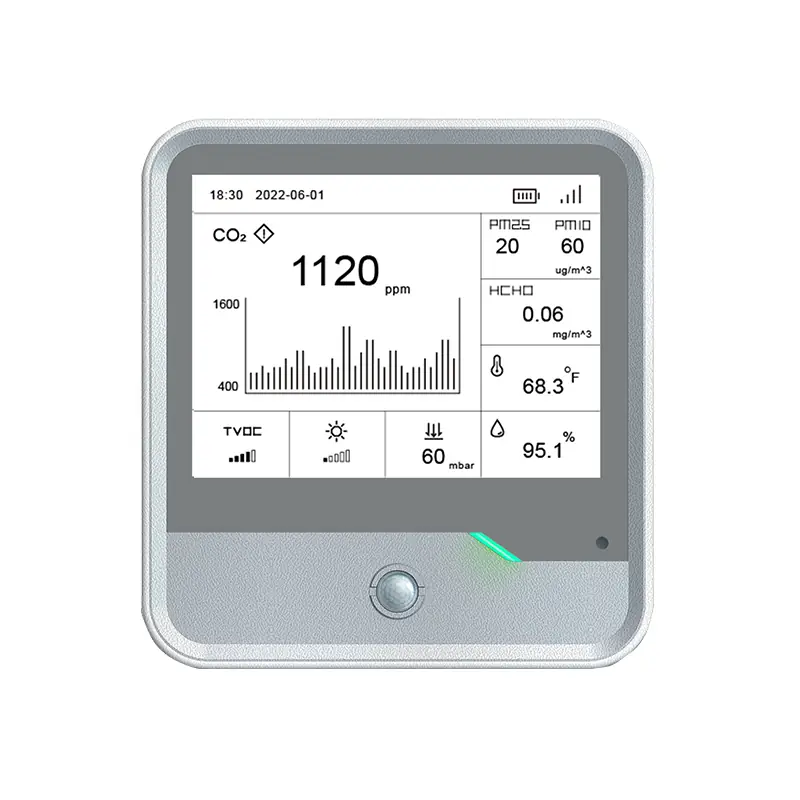
Different indoor environments may require attention to different environmental indicators, but deploying separate instruments for every parameter increases installation complexity. Their LoRaWAN Indoor Air Quality Sensor integrates multiple monitoring capabilities into one device, supporting temperature, humidity, carbon dioxide, PM2.5, PM10, TVOC, atmospheric pressure, light intensity, and optional sensing functions such as formaldehyde, ozone, and motion detection according to the selected configuration.
Using one integrated device allows facility managers to collect several environmental measurements simultaneously. This approach simplifies deployment while maintaining a consistent monitoring framework across classrooms, offices, medical rooms, and public indoor areas.
Establishing a LoRaWAN Wireless Monitoring Network with an air quality sensor
After determining monitoring locations, the next step is connecting every sensing device through a reliable communication network. Their Indoor Air Quality Sensor communicates using the standard LoRaWAN protocol, enabling environmental information to be transmitted to compatible LoRaWAN gateways before being forwarded to the corresponding network server or cloud platform.
Because the communication architecture follows the LoRaWAN standard, organizations can integrate the sensor into existing LoRaWAN infrastructure instead of building an independent wireless system. This compatibility also supports future expansion when additional monitoring points are required.
Choosing Appropriate Installation Locations for an air quality sensor
Proper installation ensures consistent monitoring results and facilitates convenient maintenance. The device supports both adhesive and screw mounting, allowing flexible deployment for various indoor environments. Battery operation further enhances flexibility when choosing installation locations.
For educational buildings, sensors may be positioned in classrooms, libraries, laboratories, or meeting rooms where indoor environmental conditions can be effectively observed. In medical facilities, installation locations may include waiting areas, consultation rooms, administrative offices, and other indoor spaces that require continuous environmental monitoring.
Accessing Monitoring Information Through an air quality sensor
Different users may need to review environmental information in different ways during daily operation. The integrated E-Ink display allows maintenance personnel to read monitoring information directly on the device while performing routine inspections. At the same time, environmental information transmitted through the LoRaWAN network can be accessed remotely through compatible cloud management platforms.
Providing both local and remote access enables facility managers to review environmental conditions without changing the monitoring workflow. This combination supports routine inspections while maintaining centralized management for larger deployment projects.
Managing Daily Operation of an air quality sensor
Routine management involves confirming both monitoring data and device operating status. The product incorporates LED indicators together with a buzzer, providing local status feedback during installation, inspection, and maintenance. These functions complement the E-Ink display by allowing personnel to understand device conditions directly at the installation location.
Since the device is designed for low-power LoRaWAN applications, it can support long-term indoor monitoring while remaining suitable for wireless deployment. Routine maintenance therefore focuses on checking device operation and communication rather than managing extensive wired infrastructure.
Expanding Indoor Monitoring Systems with an air quality sensor
Monitoring requirements often change as educational institutions and healthcare facilities continue to develop. New classrooms, offices, treatment rooms, or public service areas may require additional environmental monitoring after the initial deployment has been completed. Because their solution follows the standard LoRaWAN protocol, compatible sensing devices can be incorporated into the existing monitoring network without replacing gateways or rebuilding the communication framework.
This scalable deployment approach allows organizations to expand monitoring coverage gradually while maintaining a consistent management method. Existing cloud platforms and compatible LoRaWAN gateways continue supporting both original and newly installed devices within the same system.
Supporting Professional Indoor Monitoring with HKT LORA
Building an effective indoor monitoring system requires more than selecting individual sensing devices. A complete solution should combine reliable environmental monitoring, standardized wireless communication, flexible installation, and centralized management so that the system can adapt to different project requirements over time.
At HKT LORA, they specialize in developing professional LoRaWAN IoT products for commercial and institutional applications. Their portfolio includes LoRaWAN Indoor Air Quality Sensors, compatible gateways, and supporting cloud-based management solutions that help customers establish practical indoor monitoring systems for schools, medical facilities, offices, and other professional environments. By focusing on standard LoRaWAN technology and practical product integration, HKT LORA continues to support customers seeking reliable and scalable indoor environmental monitoring solutions.
