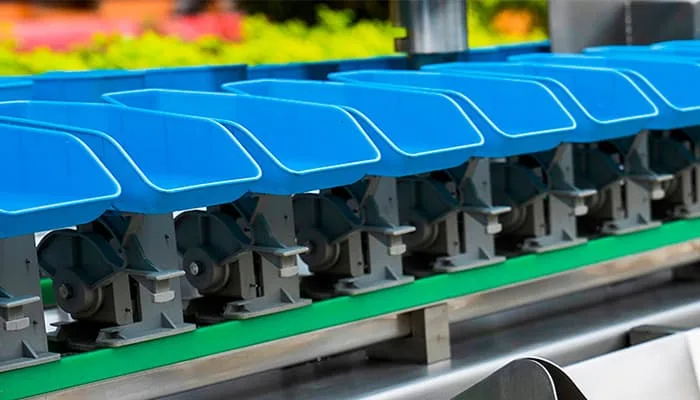
Food processing efficiency is not determined by production speed alone. A line can run quickly and still lose money through inconsistent grading, manual handling, product giveaway, or unnecessary rework. Automated sorting addresses this gap by classifying products during continuous production rather than treating sorting as a separate manual task. For food processors, the real value lies in keeping material moving while maintaining consistent weight and quality decisions.
Efficiency Starts by Removing the Manual Sorting Bottleneck
Manual sorting creates a natural limit on how quickly products can move through a processing line. Workers must inspect, classify, and redirect individual items, while fatigue and differences in judgment can affect consistency. A sorting machine shifts these repetitive decisions into an automated stage that operates as products travel through the line.
Weight-based systems measure products and assign them to predefined categories, while optical systems can evaluate characteristics such as color, size, shape, and visible defects. This distinction matters because processors can automate the classification task that creates the greatest bottleneck instead of applying one technology to every product.
Easyweigh develops sorting equipment around automated weighing and visual inspection, giving processors options for different production requirements. Its systems are designed for food processing applications where continuous classification and reliable product handling are central to productivity.
Continuous Product Flow Matters More Than Sorting Speed Alone
A fast sorter does not automatically make an entire factory efficient. If products accumulate before inspection, they require repeated manual positioning, or need additional handling after classification, the bottleneck simply moves elsewhere.
Modern sorting equipment improves efficiency by combining measurement, decision-making, and product diversion within the same workflow. Products can move along a conveyor, receive a measurement or inspection, and then be directed toward the appropriate output according to preset criteria.
That workflow is particularly useful for high-volume operations. Fish, seafood, meat portions, fruits, vegetables, and prepared foods can require frequent classification, making continuous automated handling more practical than repeated manual sorting. Weight Sorting describes applications covering seafood, fish, meat and poultry, vegetables, fruit, and prepared foods.
Consistent Classification Reduces Waste Further Down the Line
Sorting efficiency also affects what happens after classification. Uneven product weights can complicate packaging, while inaccurate grading can cause suitable products to enter the wrong category. Both situations may create unnecessary handling or material loss.
A weight-based sorting machine can separate products according to predefined weight ranges before packaging or subsequent processing. More consistent groups make downstream operations easier to manage because products entering each category have a more predictable specification.
Accurate classification can also reduce product giveaway. If products are repeatedly overfilled to avoid falling below a target weight, the excess becomes a direct cost. Weight sorting systems are designed to improve portion consistency and minimize giveaway through automated measurement and classification.
Different Food Products Need Different Sorting Logic
Food products do not present the same sorting problem. A shrimp processor may prioritize precise weight grading, while a vegetable processor may need to identify discoloration or physical defects. Meat and poultry products can also have irregular shapes that make visual and weight characteristics important at the same time.
For these environments, Weight Sorting can focus on weight-based classification, while optical inspection adds another layer of product evaluation. The combination can be useful when weight alone cannot determine whether an item belongs in the required output category.
The equipment described by Easyweigh supports applications such as shrimp and scallop grading, fish processing, irregular chicken and beef portions, and visual inspection of fruits and vegetables. This application-specific approach matters because efficiency comes from matching the inspection method to the actual source of variation on the production line.
Data and Line Integration Turn Sorting Into Process Control
Automation becomes more valuable when sorting equipment can provide information about what is happening on the line. Real-time monitoring allows operators to observe production performance and identify changes that may require adjustment.
Modern systems can also use configurable sorting parameters rather than relying on a fixed classification rule. Weight Sorting states that its equipment supports customizable sorting parameters, real-time monitoring, and integration with existing production lines.
Such capabilities change the role of sorting from a simple end-of-process separation step into part of production control. Operators can respond to changing product characteristics, adjust categories, and maintain a more consistent flow without rebuilding the entire workflow.
Where Automated Sorting Creates the Most Measurable Impact
The strongest efficiency gains usually appear where three conditions overlap: high product volume, repetitive classification, and costly inconsistency. Manual sorting becomes increasingly difficult to scale in these environments because additional throughput often requires additional labor and handling.
Automated sorting tackles the same constraints from another direction. Faster classification keeps products moving, consistent measurement reduces grading variation, and accurate diversion limits unnecessary downstream handling. For processors dealing with seafood, meat, produce, or prepared foods, these improvements can reinforce one another rather than operating as isolated gains.
The objective, therefore, is not simply to install a faster sorting machine. The greater opportunity is to connect reliable classification with the rest of the processing workflow. When measurement, inspection, diversion, monitoring, and packaging work as a coordinated system, sorting becomes a practical driver of overall line efficiency.
Easyweigh’s focus on high-precision sensing, automated sorting, real-time monitoring, and production-line integration reflects this broader approach. For food processors evaluating automation, the most useful question is not how quickly equipment can sort individual products, but how effectively it can keep the entire line moving while controlling variation, waste, and unnecessary manual intervention.
