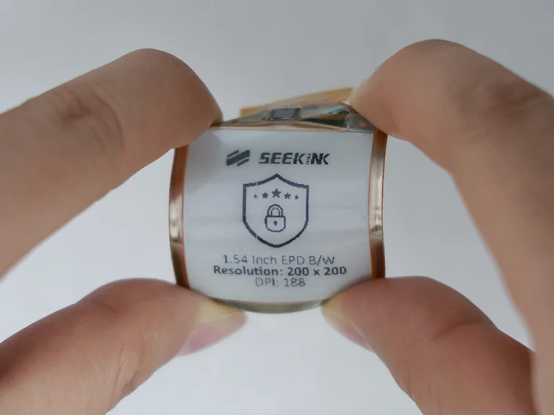
Wearable devices place unusual demands on displays because the screen may need to bend, remain lightweight, use limited power, and stay readable in everyday lighting. A flexible e ink display can support these needs when the product is intended for labels, badges, small accessories, or other wearable forms that do not require fast video.
A flexible e paper display is especially useful when designers need a thinner or more adaptable screen shape than a rigid panel can provide.
SEEKINK’s 1.54-inch flexible ePaper display module combines a 200 × 200 reflective display, ultra-low power consumption, SPI connectivity, and integrated power management, making it suitable for compact, battery-powered devices.
These details show that flexible e-paper is a technical component for careful integration. The design process should therefore begin with the body shape and wear condition instead of starting only from the display specification.
Why Flexibility Matters in Wearables
The main reason to use a flexible e ink display is to fit a product shape that cannot be handled comfortably by a rigid screen. Wearables may curve slightly against clothing, hang from a lanyard, attach to a bag, or sit inside a compact accessory. SEEKINK’s module is described as a flexible active matrix electrophoretic display, which makes it relevant for designs where physical adaptability matters.
A flexible e paper display should still be chosen according to the actual bending and mounting requirements, not only because the word flexible sounds appealing. If the product does not need a curved or thin form, a rigid module may be simpler. Designers must consider active area, connector placement, protective layers, enclosure stress, and how the display will be touched or bumped during use.
Flexibility is useful only when it improves comfort, durability, or product shape. A wearable display must also remain readable while moving with the user, which makes glare treatment and viewing orientation more important.
Readable Static Information with Low Power
Wearables often need to show information for long periods without constant charging. A flexible e ink display can help because e-paper is suited to static text or graphics that remain visible after refresh. SEEKINK lists pure reflective mode, a hard-coat antiglare surface, and ultra-low current deep sleep mode, all of which are relevant for portable accessories.
A flexible e paper display with 200 x 200 resolution can support compact icons, labels, simple codes, or short text rather than dense documents. The technical page also mentions landscape and portrait modes, which gives designers some layout freedom. Power behavior should be evaluated with the full device in mind, including the controller, wireless system, sensors, and battery.
The display is only one part of the wearable, but choosing a low-power screen can make the overall product more practical for repeated daily use. Low power behavior is useful only when the rest of the device is also designed to avoid unnecessary energy consumption.
Integration Details for Product Designers
The technical integration of a flexible e ink display requires more than attaching a panel. SEEKINK’s official information refers to on-chip display RAM, waveform storage in on-chip OTP, serial peripheral interface support, an internal temperature sensor, an oscillator, and integrated booster and regulator control for generating VCOM, gate, and source driving voltage.
These features matter to engineers who need stable refresh behavior and compact electronics. A flexible e paper display must be matched with suitable firmware, power management, mechanical protection, and test procedures.
The module’s 1-bit black-and-white capability should also be considered. It can be very effective for simple wearable information, but it is not intended for full-color visual storytelling. A careful article should therefore place the module within realistic use cases, such as smart tags, wearable identifiers, accessory screens, or other low-motion displays.
These details show why flexible e-paper projects need cooperation between mechanical design, electronics, and software planning.
Flexible e-paper screens can be valuable in wearable devices when the product needs a readable, lightweight, and shape-aware display. A flexible e ink display supports static information while allowing a form factor that may be more comfortable than a rigid screen. A flexible e paper display can also help reduce power demands when the content changes only occasionally.
SEEKINK’s 1.54-inch module offers official details that support these points, including 200 x 200 resolution, reflective viewing, antiglare surface treatment, portrait and landscape support, deep sleep mode, internal sensing, display RAM, SPI support, waveform storage, and integrated driving controls. These specifications should be discussed as engineering material rather than broad promises.
The most suitable wearable applications are those where the screen must be small, readable, efficient, and physically adaptable.
When those needs are present, flexible e-paper can become a practical component in smart wearable design. When used carefully, the display supports a quieter type of wearable device that presents stable information without demanding constant attention. This is why official module specifications should be paired with careful product testing before a wearable design is finalized.
SEEKINK helps frame that decision through flexible display examples that connect bendable structure with wearable-device constraints.
