Field teams working in marine operations, oil and gas facilities, chemical plants, and other industrial environments need dependable gas monitoring equipment to identify atmospheric hazards. The best portable instruments combine suitable gas coverage, reliable sensors, clear alarms, practical sampling methods, and durable construction. In 2026, buyers should compare equipment according to workplace risks rather than brand popularity alone.
Options such as the MSA ALTAIR 4XR, Dräger X-am 2800, Honeywell BW Flex, and Bosean K-600 address different monitoring requirements. Understanding their capabilities can help industrial businesses select appropriate equipment for worker protection and operational safety.
What Field Teams Should Look for in Portable Gas Monitoring
Selection begins with a site risk assessment. Tank-entry crews may need oxygen, combustible-gas, carbon-monoxide, and hydrogen-sulfide readings, while marine teams may also require carbon-dioxide monitoring. A four-gas configuration is not automatically sufficient.
Sampling method also matters. Diffusion units monitor air around the wearer; a built-in or attachable pump draws samples through a hose before entry into a tank or vessel. A portable gas detector should provide recognizable alarms and a readable display. Teams should confirm that the chosen portable gas detector supports their actual sampling procedure.
Four Models to Compare in 2026
- MSA ALTAIR 4XR: Rugged Four-Gas Monitoring for Field Teams
The MSA ALTAIR 4XR is a portable four-gas detector designed for applications such as confined-space entry, oil and gas operations, plant maintenance, and emergency response. Equipped with MSA XCell sensors, it supports rapid gas detection and configurable monitoring of combustible gases, oxygen, and selected toxic gases.
Standard configurations can monitor combustible gases (LEL), oxygen (O₂), carbon monoxide (CO), and hydrogen sulfide (H₂S). Other sensor combinations are available for specific monitoring requirements, including sulfur dioxide (SO₂) and nitrogen dioxide (NO₂).
Durability is a key feature of this instrument. The ALTAIR 4XR carries an IP68 rating and is designed to withstand accidental drops, including a 7.5-meter drop onto concrete under specified conditions. Its rechargeable battery provides up to 24 hours of operating time, while the four-year instrument and sensor warranty supports long-term fleet planning.
For confined-space applications, an optional ALTAIR Pump Probe enables remote sampling before entry. Its MotionAlert and InstantAlert options provide additional ways to notify others when users encounter potentially dangerous situations. These features make the ALTAIR 4XR a practical option for field teams prioritizing rugged construction, configurable four-gas monitoring, and straightforward operation.
- Dräger X-am 2800: Compact Monitoring with Data Connectivity
The X-am 2800 measures one to four gases and is intended for personal air monitoring and confined-space entry. Its sensor options include combustible gases and vapors, oxygen, carbon monoxide, hydrogen sulfide, nitrogen dioxide, and sulfur dioxide.
Dräger lists IP68 protection and typical operating time above 12 hours, making it relevant to teams prioritizing enclosure protection and digital records. Bluetooth connectivity and compatibility with Gas Detection Connect provide additional options for transferring monitoring data and managing equipment.
- Honeywell BW Flex: Configurable Wearable Monitoring
The BW Flex platform supports four-gas or five-gas configurations, depending on the model and sensor selection. Available sensor choices cover combustible gases, oxygen, carbon monoxide, hydrogen sulfide, and other gases, including selected infrared options.
Its compact format, visual, audible, and vibration alarms, and Bluetooth connectivity are relevant to teams that need wearable monitoring and device-management support. Honeywell lists IP66/IP68 protection. Runtime varies by sensor package, so buyers should check the exact configuration.
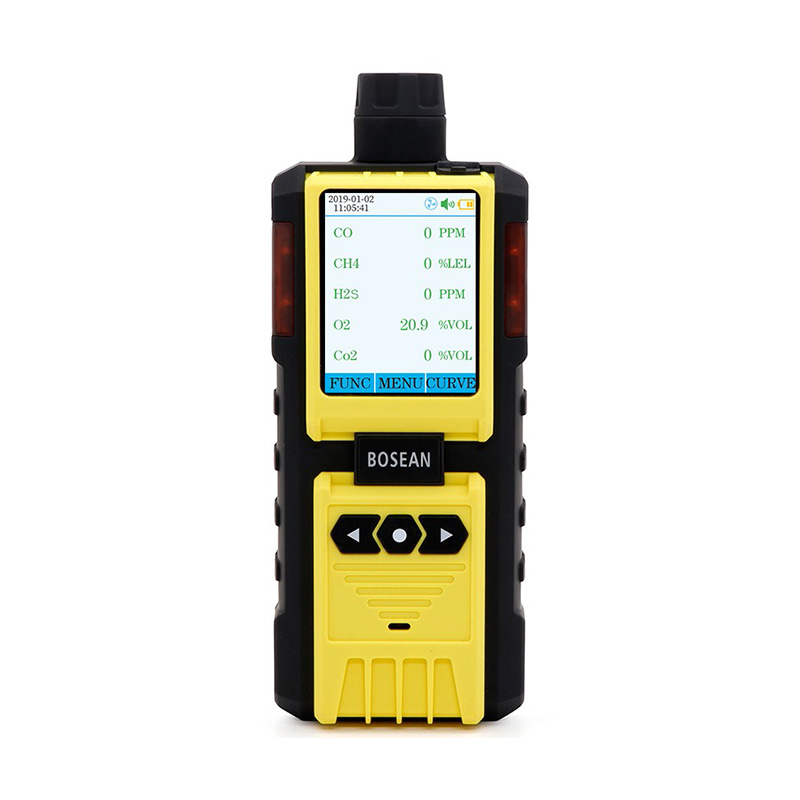
- BoseanK-600 Marine: Pumped Five-Gas Monitoring
The Bosean K-600 Marine is designed for shipboard environments, including engine rooms, cargo holds, pump rooms, ballast tanks, and confined-space entry points.
Its specified marine configuration monitors carbon monoxide (CO), hydrogen sulfide (H₂S), oxygen (O₂), carbon dioxide (CO₂), and methane (CH₄). It combines NDIR sensors for CO₂ and CH₄ with electrochemical sensors for O₂, CO, and H₂S.
A built-in pump supports remote sampling, while the color display can show gas curves and readings. Product information also lists audible, visual, and vibration alarms, storage for up to 1,200 records, at least eight hours of continuous operation without alarms, and IP65 protection.
For marine operators, the K-600 offers a purpose-configured option when these five gases match the vessel’s risk assessment.
How to Choose the Right Instrument for a Field Team
Compare more than purchase price. Match sensors to site gases, decide whether workers need diffusion monitoring or pumped pre-entry sampling, and verify hazardous-area approvals and ingress protection.
Assess battery life against shift length, pump use, connectivity, temperature, and alarm activity. Also check display readability, controls, charging, calibration equipment, sensor replacement, and service availability. A portable gas monitor requires maintenance, bump tests, and calibration under manufacturer instructions and site procedures.
Fleet buyers should request datasheets, certificates, sensor compatibility details, and calibration guidance. For confined-space entry, detection equipment supports but does not replace permits, ventilation, attendant duties, rescue planning, and required continuous monitoring.
Before purchasing a portable gas detector, organizations should also evaluate the supplier’s technical support, customization capabilities, and availability of replacement sensors. A portable gas detector selected with these considerations can help reduce equipment mismatches and simplify long-term fleet management.
Matching Equipment to the Work Ahead
No single instrument is best for every field team. Industrial Scientific, Dräger, and Honeywell offer established wearable platforms with different sensor, connectivity, and management features. Bosean‘s K-600 Marine stands out for buyers seeking a pumped five-gas configuration aimed at shipboard enclosed spaces, particularly where CO₂ and methane monitoring are part of the specified hazard profile.
The strongest purchasing decision comes from matching the device to site gas risks, sampling needs, approvals, operating hours, and maintenance capacity. Organizations evaluating a portable gas monitor should compare complete configurations rather than model names alone. By checking these details with suppliers and integrating equipment into a disciplined safety program, industrial buyers can equip field teams with monitoring tools suited to their actual working conditions.
