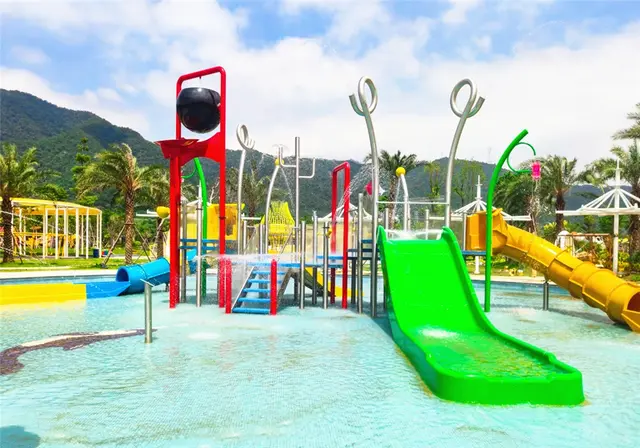
Community parks rarely have the budget to build every feature in one go. A water play project that can be built in stages, with a core structure first and extra features later, is easier to fund, easier to approve, and easier to adjust once residents start using it.
Jinchao, a water park manufacturer, develops aquatic play concepts for settings ranging from public parks and hotels to community facilities, reflecting a broader shift from passive pool areas toward spaces that can accommodate different ages, abilities, and styles of participation.
Phase the Project to Match Funding
A first phase can include the base infrastructure and a core structure with a few well-chosen features. Water supply, drainage, power, and the equipment room are the hardest items to modify later, so they should be sized for the full project even if only part of it is built at the start.
Later phases can add features as budgets allow. Leaving spare connection points, clear deck space, and room in the plant room means new slides, sprays, or interactive elements can be added without breaking up finished work. Drawings should show these future positions so that nothing built now blocks them.
Procurement should follow the same plan. Writing the specification for the full project and pricing each phase separately lets the municipality compare suppliers fairly and keep the same standards across phases, which is much harder if each stage is tendered from scratch.
Designing for Different Users
Inclusivity starts with understanding that children do not interact with water in the same way. Some may enjoy active spray effects, while others prefer watching, touching, or moving gradually through the space. Inclusive community recreation benefits from having several levels of engagement rather than expecting every visitor to participate in one prescribed activity.
Caregiver visibility should also influence the physical arrangement. Raised barriers, dense landscaping, or poorly positioned structures can make supervision difficult even when the play equipment itself is suitable for children. Clear sightlines, accessible routes, comfortable seating, and logical entry points allow adults to remain connected to the activity without obstructing circulation.
The surrounding surface matters just as much as the water features. Wet pedestrian routes need suitable traction and effective drainage, while transitions between dry and wet areas should be easy to understand. Within community splash parks, designers can separate active play from quieter zones so that younger children, older children, and accompanying adults have room to use the environment without excessive conflict.
Another consideration is adaptability. Jinchao’s Water House is designed for amusement parks, hotel swimming pools, and similar aquatic venues, with a pool area of approximately 200–500 square units. Its hot-dip galvanized steel and fiberglass slide construction supports a customizable theme, allowing the visual concept to be adjusted to the character of the surrounding venue without making the product description the focus of the entire space.
Turning Recreation Into a Community Asset
The value of aquatic recreation extends beyond the hours when children are actively playing. Well-planned water play for communities can become part of a neighborhood’s social infrastructure, giving families a reason to gather outdoors during warm weather. The surrounding landscape can support this role through shaded seating, picnic areas, walking routes, and convenient access to restrooms.
Programming can further expand how a facility is used. Community organizations might incorporate seasonal events, family activity days, or educational programs related to water safety and the environment. Such additions do not necessarily require major physical changes; they depend more on whether the original layout leaves enough room for different types of use.
Operational planning deserves similar attention. A Water Play Structure requires suitable water management, drainage, inspection access, cleaning procedures, and maintenance routines. Equipment placement should leave practical routes for staff, while mechanical components should remain accessible for servicing. These considerations are easy to overlook when visual appearance dominates the early design process.
Long-term planning also affects material selection. Public facilities experience frequent contact, repeated cleaning, weather exposure, and seasonal fluctuations. Designers need to consider corrosion resistance, surface condition, replacement access, and compatibility with the local climate. The objective is not simply to create an attractive installation but to establish an environment that can be maintained realistically over time.
Planning the Next Generation of Public Spaces
Municipalities considering public water play spaces may find that aquatic recreation works best when integrated with other community amenities. A play zone positioned near walking trails, sports facilities, libraries, or neighborhood gathering areas can become part of a broader recreational network. Its usefulness then depends less on one attraction and more on how naturally visitors move through the entire site.
Budget planning should account for infrastructure as well as visible features. Water supply, treatment, drainage, electrical service, shade, surfacing, landscaping, accessibility improvements, and ongoing maintenance can all influence project costs. A realistic assessment of these elements gives planners a clearer picture of what the site can support before construction begins.
For locations with sufficient outdoor space, outdoor water playgrounds can provide a seasonal destination without requiring the depth and operational model of a traditional swimming pool. Climate, local regulations, opening periods, and water-quality requirements still need careful consideration, particularly in regions with large temperature variations.
Conclusion
The transition from pools to playgrounds reflects a broader understanding of what public aquatic spaces can provide. A phased plan lets communities start with a safe, well-built core and grow it as use and funding allow, while accessible circulation and flexible programming keep the finished space useful.
Jinchao‘s aquatic recreation experience illustrates how customized structures can fit different settings, while Water Play Structure planning, accessible circulation, and flexible programming can shape the usefulness of the finished environment. With careful coordination, public water play spaces can become more than seasonal amenities, giving communities places where recreation, social connection, and everyday outdoor life naturally overlap.
